How an AI Evidence Chronology Tool Supports Cases
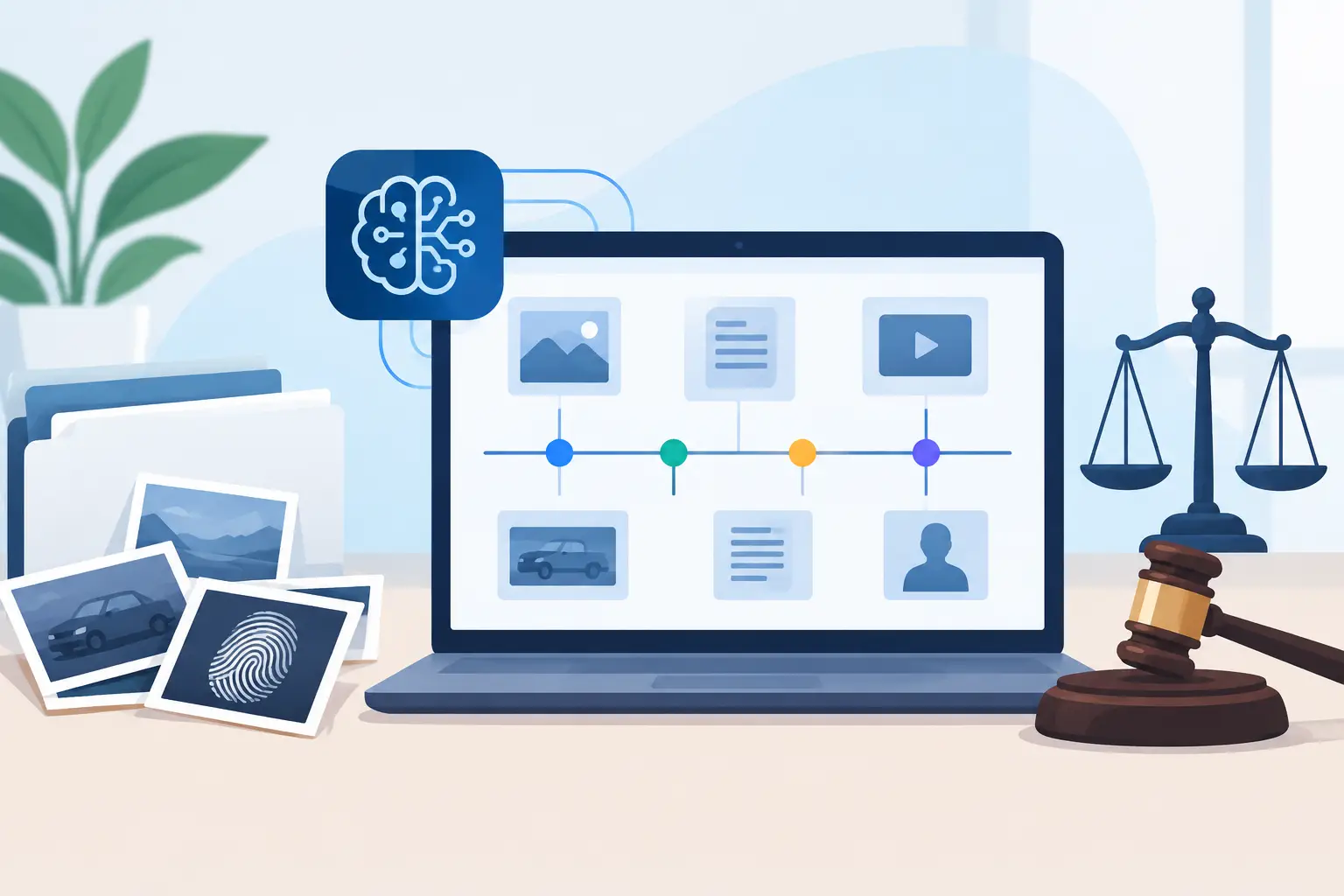
A disputed termination may turn on a 43-second voice note sent after an employee’s final email. A property matter may hinge on the date visible in a photograph of a signed deed. An AI evidence chronology tool should help a legal team find those facts in context, place them in sequence, and return to the original material without asking anyone to trust a summary alone.
That distinction matters. A chronology is not merely a list of dates. It is a working record of what the evidence shows, when it occurred, who or what the source is, and where the underlying proof can be verified. For document-intensive matters, the challenge is not simply producing a timeline. It is building one without losing provenance, qualification, or the ability to test each entry against the source.
What an AI evidence chronology tool should do
A useful chronology system begins before the timeline view. It must ingest varied evidence types, preserve the original materials, extract usable text, and make individual facts traceable to a source location. Otherwise, a polished sequence of events can become another unverified work product that must be reviewed from scratch.
In a typical case file, relevant events are scattered across email chains, WhatsApp conversations, PDFs, spreadsheets, photos, call recordings, hearing video, and cloud folders. Dates may appear in metadata, message headers, document language, filenames, or spoken testimony. Some materials may be scanned, forwarded, incomplete, or created in a different time zone.
The system’s role is to organize and surface facts. It should not decide whether a witness is credible, whether a contract was breached, or what legal theory prevails. Those are professional judgments. The operational objective is narrower and more defensible: identify potentially relevant events, connect them to their sources, and give the legal team a faster path to verification.
A chronology entry needs more than a date
A defensible entry should retain the factual statement, the event date or date range, the source identity, and a direct reference back to the original record. Depending on the file type, that reference may be a PDF page, an email message, a chat passage, an audio timestamp, a video timestamp, a spreadsheet row, or a metadata field.
Consider a wage dispute. A spreadsheet may show hours entered on March 14. A supervisor’s email may approve those hours on March 16. A voice message recorded on March 18 may dispute the entry. The chronology should preserve these as separate facts with their respective dates and sources, rather than compressing them into a conclusion such as “hours were contested.” The latter may be a useful case note, but it is not a substitute for evidence.
Build the record before asking questions
The quality of any chronology depends on the completeness and integrity of the case record. Loading only the documents that appear favorable can obscure sequence, context, and gaps. Loading duplicate or altered copies without a controlled process can create uncertainty about what was actually reviewed.
A disciplined workflow starts by bringing the available evidence into a case-level record. This can include loose files and read-only cloud sources, as well as exports from communication platforms. The platform should preserve the original file and create a searchable representation through transcription, optical character recognition, indexing, and structured extraction.
At import, integrity controls matter. SHA-256 fingerprints can identify the file received at a point in time. Immutable source references help maintain the connection between extracted text and the original evidence. Action logs establish who uploaded, reviewed, or organized materials. Case-level isolation and encryption in transit are not presentation features. They are part of the handling model for sensitive legal evidence.
TranscriptMe applies these controls while making the resulting record searchable across file types. The practical benefit is straightforward: a team can work from one organized evidence set while retaining the source material needed to test any factual proposition.
How the chronology is assembled in practice
Once the case record is indexed, the work becomes an iterative review process. AI can accelerate the first pass by identifying dates, participants, communications, documents, and references to events. The legal professional then verifies the items that matter and applies the case context that automated extraction cannot supply.
1. Normalize dates without hiding uncertainty
Not every date is equally reliable. A message timestamp may be precise; a witness statement saying “the following weekend” is not. A scanned letter may show a date in the body that conflicts with file metadata. An AI chronology tool should preserve the basis for the date and flag ambiguity where appropriate.
This is especially relevant in cross-border communications and mobile exports. A timestamp may reflect the sender’s device, the receiving platform, or a later export process. When timing is disputed, the chronology should show the source timestamp and let the team assess time zones, transmission timing, and authentication evidence.
2. Keep related evidence together, but not merged
A single event may be reflected in several records. An executive sends an instruction by email, discusses it in a meeting recording, and later references it in a text message. These records may corroborate one another, or they may reveal differences worth examining.
The chronology should connect related materials while keeping each source distinct. That lets counsel see the sequence and compare wording. It also prevents an inferred narrative from being treated as if it came from one document.
3. Ask factual questions against the record
Natural-language search is useful when it produces answers with exact support. A reviewer may ask: “What communications mention the revised commission plan?” or “Show every record discussing access to the warehouse after April 3.”
The useful response is not simply a generated paragraph. It identifies the responsive materials and cites the exact message, passage, page, timestamp, row, or metadata record. The reviewer can then open the source, assess the language, and decide whether the fact belongs in the working chronology.
4. Review gaps as actively as hits
A timeline can be misleading when it suggests continuity that the evidence does not establish. If a key conversation is referenced but absent, that absence may need investigation. If an email thread skips an attachment, the chronology should not imply that the attachment was reviewed.
Teams should use the chronology to identify missing periods, unexplained references, conflicting dates, and duplicate versions. In many matters, these gaps are as useful as the documents already collected. They shape preservation requests, witness preparation, discovery follow-up, and targeted client questions.
Where AI helps, and where it does not
AI is well suited to high-volume review tasks that otherwise consume hours of manual sorting. It can transcribe an audio interview, extract text from a photographed contract clause, identify date-bearing messages across a large chat export, and surface every reference to a particular account, property, employee, or shipment.
It is less suited to making legal or evidentiary conclusions. A system may identify that a message mentions a payment, but it cannot reliably decide whether the payment was authorized, whether a statement is hearsay for a particular purpose, or how a jurisdiction will treat the evidence. It may surface an apparent inconsistency, but counsel must determine whether the difference is material, explainable, or admissible.
The trade-off is clear. Faster organization can reduce the time spent locating facts, but speed is only valuable if the resulting work remains reviewable. A team should be able to challenge any timeline entry by opening its source, reading the surrounding context, and understanding how the date was derived.
A practical review standard for legal teams
Before relying on a chronology for a pleading, interview, examination outline, or settlement assessment, apply a simple evidentiary standard: can the team locate the original source immediately, identify the relevant passage or timestamp, and explain what the record does and does not establish?
If the answer is no, the entry may still be a useful lead. It should not yet be treated as a settled fact. That distinction protects the work product from a common failure of automated review: confusing a plausible extraction with verified evidence.
For significant events, reviewers should check the original material, capture surrounding context, confirm the event date and time basis, and note competing accounts. Where an item is inferred from multiple sources, label it as an inference rather than attributing the combined proposition to a single record.
A well-built chronology does not replace close reading. It gives close reading a better order of operations. Start with the source-backed event, verify the context, and let the case theory follow the evidence rather than the other way around.